Set of 3 volley balls x3


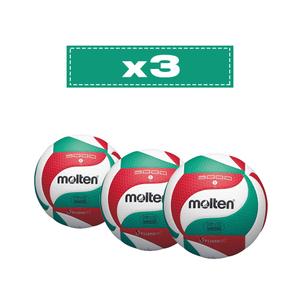


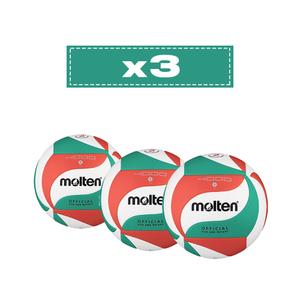


In the garden, on the beach, or against the gym wall before the session, the pack of 3 volley balls provides enough to play without chasing after the ball for every mistake.
It's the format for the player working on their serve, for a small group of friends setting up a sand court, or for the coach who wants a match ball and two spare balls.
Set of 3: the singles service format
A player who wants to improve their serve needs repetition. With just one ball, they serve, cross the court, pick it up, and come back. With three, they can do three serves in a row, then gather them all at once: the session counts for double the hits in the same time. The same applies to the forearm pass against a wall or high passes on their own.
Three sand balls for a bunch of friends
On sand, a ball can quickly get blown away into the dunes or end up in the water. The set of 3 allows the game to continue while one player runs to recover it. You'll find the OPTX AVP from Wilson, the official ball of the American professional circuit, the Mikasa Beach Classic BV551C, and the beach balls from Molten, including the V5B1300 Breizh for relaxing games at the campsite.
Set of 3 for indoor: from official matches to leisure
Indoors, the page covers all levels. The Molten V5M5000 and the Mikasa V200W are high-end competition balls. The Mikasa V330W, made of composite material, is suitable for both matches and training. The Molten V5C1400 and the Nike All Court are more aimed at leisure and outdoor play on a clean surface.
Mikasa, Molten or Wilson for a smaller format
- Molten offers competition sets and lighter training models like the V5M2000-L.
- Mikasa, provider of the official FIVB balls, offers its V200W, V300W, and V330W.
- Wilson focuses on the Helix for indoor and the OPTX AVP for sand.
- Nike adds its versatile All Court.
Set of 3 or larger allocation
For a whole team, switch to an intermediate format or the club allocation, which offer the same models. The page ball sets gathers all formats. To pay less, keep an eye on the special ball offers and the page ball clearance.
Frequently asked questions
Is a set of 3 balls suitable for a beginner?
Yes, as long as you choose the right model. A beginner or a teenager will feel more comfortable with a lighter training ball, which is gentler on the forearms. Competition balls, which are firmer, make more sense when the technique is already in place.
Can you give a set of 3 balls as a gift?
It's a practical gift for a family who plays in the garden or for a friend who is setting up a beach court. Choose a sand ball for the beach, and a versatile ball for outdoor use. Don't forget to add a pump, as volleyballs need to be regularly re-inflated.
What's the difference between a beach ball and an indoor ball in a set?
The beach ball is softer and less inflated, making it more manageable in the wind and pleasant for bare-handed forearm passes. The indoor ball, which is firmer, flies faster. Both don't interchange well: choose the set that suits your playing area.
How to make a ball last when using it outside?
Rinse it with clear water after a day on the sand and let it dry in the shade. Avoid leaving it in the sun in a car; the heat can damage it. On concrete, prefer a stitched ball to a competition ball with glued panels.
Is a set of 3 useful for a coach?
For a youth coach or a personal trainer, it's an effective base: one ball to use, two in reserve. To run collective exercises with the whole team, a larger allocation will be needed.